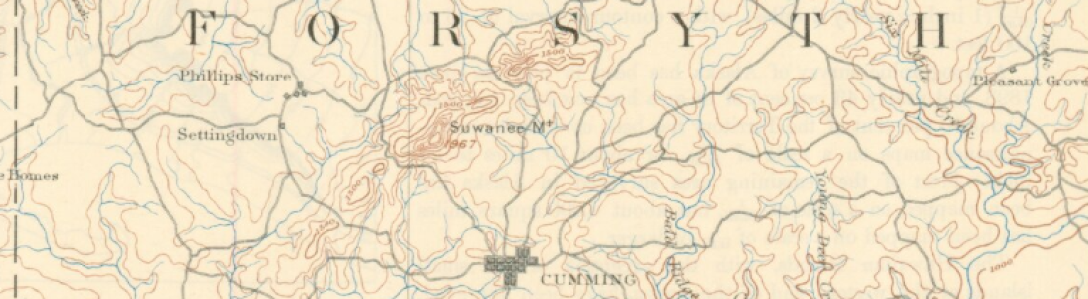
On May 14, 1910, Morgan Strickland, a Black farmer in Forsyth County, Georgia, purchased 37.5 acres of land from N. J. Buice. The sale was recorded in the Forsyth County deed records (Deed Book Z, Page 498)1. The property was located in Land Lot 1012, and the purchase price was $425.

Tax records show Morgan paying property taxes on Land Lot 1012 in 1911 and 19122. He continued to appear on the tax digest for that land in 1914, 1916 (through an agent), and 19173. He is absent from the tax rolls in 1913, 1915, and after 1917.
No record has been found of Morgan selling this land. His name does not appear as a grantor in any indexed deed books in Forsyth County.
By the 1920 and 1930 federal censuses, Morgan was living in Duluth, Gwinnett County, as a renter4.
Tracing the Land After Strickland
A title search of Land Lot 1012 leads to a deed recorded on October 8, 1919, in which Willis O. Harris sold the property to Mrs. Pearl Anglin for $1,1005. This and several other deeds from the same time period refer to the land as the “Morgan Strickland Place,” indicating a local understanding that this was formerly Morgan’s land.
However, no deed has been located showing how Willis O. Harris acquired the land. His name does not appear in the indexed deed records as a grantee.
From that point, the property changed hands multiple times over the 20th century. In 1974, a plat filed by Thomas H. Mitchell Jr. introduced Hope Drive6. In 2005, Forsyth County approved zoning application ZA3036, which created the Cascade Run subdivision7. The neighborhood includes 15 homes built shortly after the zoning approval. Today, these homes sell for approximately $1.25 million.
Missteps in the Record
Pulitzer Prize-winning journalist Elliot Jaspin discusses Morgan Strickland’s land in Buried in the Bitter Waters: The Hidden History of Racial Cleansing in America8. However, his account misidentifies the relevant land lot in a deed involving M. O. Terry. While the deed itself is legitimate, a common clerical error in listing the land lot appears to have led to a mistaken conclusion. The true gap in the title history seems to lie elsewhere.
This underscores how even respected research can falter when faced with fragmented or inconsistent historical records. For this project, we aim to clearly separate what is known, what is plausible, and what is uncertain.
A Complex Picture
Morgan Strickland’s case may appear to suggest an erasure of Black landownership, but it is not representative of every outcome. Many Black families in Forsyth County did eventually sell their land. Some sales occurred soon after the 1912 violence, while others happened years later. Although not all transactions were fair or voluntary, most were at least documented.
Morgan’s case stands out because there is no clear record of a sale. That gap does not prove wrongdoing, but it does highlight the ease with which a landowner’s presence could disappear from the historical record.
What We Still Don’t Know
There are still open questions. Was the land lost to unpaid taxes? Sold informally without a recorded deed? Taken through a legal process such as a sheriff’s sale that was never indexed? Or is there a missing record still waiting to be found?
For now, we don’t know. But we’re still looking.
Footnotes
- Forsyth County Clerk of Superior Court, Deed Book Z, p. 498. ↩
- Forsyth County Tax Digest, 1911 and 1912. ↩
- Forsyth County Tax Digest, 1914, 1916 (entry via agent), and 1917. ↩
- 1920 U.S. Census, Gwinnett County, Georgia; 1930 U.S. Census, Gwinnett County, Georgia. ↩
- Forsyth County Clerk of Superior Court, Deed Book 5, p. 136. ↩
- Forsyth County Clerk of Superior Court, Plat Book 10, p. 218. ↩
- Forsyth County Board of Commissioners, Zoning Application ZA3036, approved January 26, 2005. Retrieved via Forsyth County Customer Self-Service Portal.. ↩
- Jaspin, Elliot. Buried in the Bitter Waters: The Hidden History of Racial Cleansing in America. Basic Books, 2007. ↩

 Lost Black Land of Forsyth County