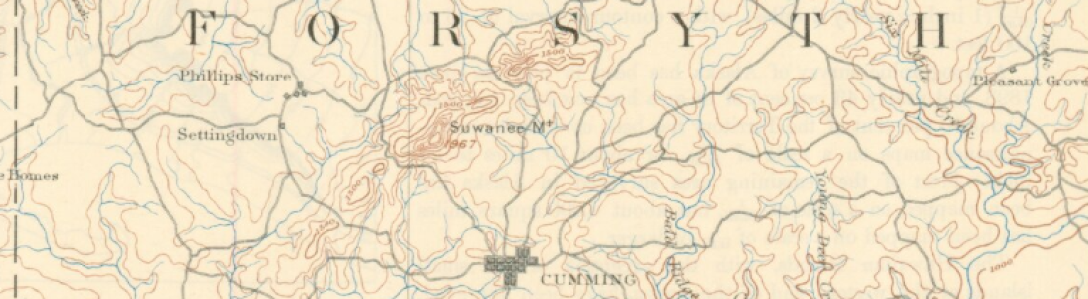
In the fall of 1912, Garrett Cook sold his 27-acre property in Forsyth County, Georgia1 2. All available records suggest he was the first Black landowner to do so following the outbreak of racial terror that year. Cook’s decision to sell was not made freely. It came after armed men attacked his home and he and his wife, Josie, were forced to hide in the woods overnight to survive.
Garrett Cook was about 51 years old in 1912, likely born during the Civil War. Like many Black landowners in Forsyth County, he was among the first generation to secure land ownership after emancipation3. His property was located in the New Bridge Militia District, a part of the county known today as Oscarville. Cook was the only Black landowner in that area, and one of very few Black residents there at all4.
Oscarville sat near the center of the storm. Just about a mile from Cook’s land was Pleasant Grove Baptist Church, where the funeral for Mae Crow was held in late September 1912. Mae Crow, a young white girl, had been beaten and assaulted earlier that month, and her death became the spark for the violence that followed.
According to accounts collected in Patrick Phillips’ book Blood at the Root, the night after Mae Crow’s burial marked a turning point. Armed white men began shooting into homes and burning property. One white farmer, George Jordan, attempted to check on Garrett and Josie Cook but was chased off by a group of armed men. At first light, he returned and found their home riddled with bullets. The legs of the tables, chairs, and bed had been shot away. Garrett and Josie had hidden in the woods to avoid being killed. When Jordan urged Cook to return and defend the property, Cook replied that doing so would only get them both killed5. He left Forsyth County for good.
This account was preserved through a 1980 handwritten testimony and later interviews with descendants of the Jordan family, as documented in Blood at the Root by Patrick Phillips.
The Timeline of Events
Understanding the context of Cook’s sale requires looking at the timeline of events in September and October 1912:
- Sept 8: Mae Crow goes missing
- Sept 9: Mae Crow is found beaten and raped
- Sept 10: Rob Edwards arrested and lynched in downtown Cumming
- Sept 23: Mae Crow dies from her injuries
- Oct 3: Trial of Ernest Knox and Oscar Daniel begins
- Oct 4: Both are sentenced to death
- Oct 10: Newspaper articles begin reporting the Black expulsion
- Oct 11: Garrett Cook sells his land
- Oct 25: Knox and Daniel are executed
Cook’s land sale occurred just one week after the trial ended and two weeks before the executions. His sale appears in Forsyth County deed records dated October 11, 1912, with the deed recorded on October 22. Notably, the document still lists him as “of Forsyth County,” suggesting he may not yet have resettled elsewhere. In contrast, future deeds involving other Black families begin to show sellers identified as residents of other counties, indicating that many families fled first and dealt with legal matters later.
A Targeted Departure
Author Elliot Jaspin has noted that Garrett Cook was the first Black landowner to sell his property during the 1912 racial purge6. The records support that claim. While the number of Black residents in Oscarville was small, the violence there may have marked the first full eruption of terror. The story of the Cook family being driven into the woods while their home was shot apart points to a targeted, early act of racial cleansing.
Cook’s land was not simply abandoned. He was able to sell it, but the sale occurred under extreme duress. His story challenges the idea that Forsyth’s Black residents left voluntarily. This was not a quiet departure. It was a forced one.
Looking Ahead
In future posts, we will explore the stories of other families who were driven from Forsyth County. Some sold their land quickly, others fled and never returned to complete a sale. In Garrett Cook’s case, the violence came early, and the record of his sale helps mark the beginning of a tragic chapter in Forsyth County’s history.
Sources
- Forsyth County Deed Book 5, p. 139. Forsyth County Clerk of Court, Cumming, GA. (Cook sale)
- Forsyth County Deed Book 5, p. 157. Forsyth County Clerk of Court, Cumming, GA. (Purchase by white buyers)
- Forsyth County Tax Digest (1912), “Colored Digest,” New Bridge Militia District. Georgia State Archives, Morrow, GA.
- United States Census Bureau, 1900–1930.
- Phillips, Patrick. Blood at the Root: A Racial Cleansing in America. New York: W. W. Norton & Company, 2016, pp. 67–68.
- Jaspin, Elliot. Buried in the Bitter Waters: The Hidden History of Racial Cleansing in America. Basic Books, 2007, p. 135.

 Lost Black Land of Forsyth County