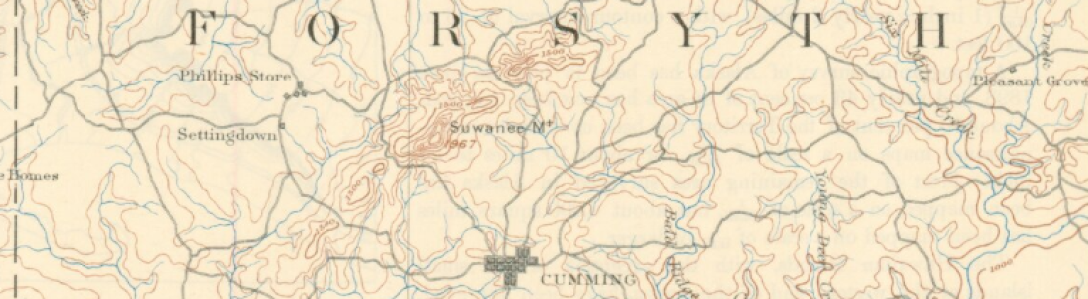
In recent years, Oscarville has become the focus of a viral narrative, one filled with ghosts, conspiracies, and submerged truths. It’s a story told in horror films, TV shows, and social media posts. But as compelling as it may sound, much of what is said about Oscarville is wrong.
If we want to understand what really happened in Forsyth County in 1912, we need to separate fact from fiction.
The Myths
Two recent pop culture works have helped fuel the Oscarville myth. One is Lanier, a low-budget horror movie about a haunted lake1. The other is the third season of FX’s Atlanta, which includes a fictional storyline about Oscarville being a thriving Black town violently destroyed and erased from history by Lake Lanier2. Wikipedia and other websites have repeated and expanded on these claims3.
Some of the most common false claims include:
- That Oscarville was “another thriving Black Wall Street”4
- That it was a “majority-Black town”5
- That it was “a bustling 1800s Black community full of blacksmiths, bricklayers, and carpenters”6
- That Lake Lanier was created to deliberately cover up the town’s past
- That the lake is haunted by Oscarville’s history
Other online sources and videos go further, conflating Oscarville with the entire 1912 expulsion of Black residents from Forsyth County. While these may be well intentioned, they miss the mark and obscure the real story.
The Facts
Oscarville was not a town in any formal sense, and it was never a majority-Black community. In the 1910 federal census, Oscarville fell within the New Bridge Militia District, which had:
- 100 households
- 513 total people
- Only 7 Black households, representing just 37 Black residents7
Only one Black household owned land: the family of Garrett Cook, whose land ownership is documented in Forsyth County tax rolls and deeds8.
By contrast, Forsyth County as a whole had over 1,000 Black residents living in about 220 households in 1910. Most Black families lived in other parts of the county, not in Oscarville.
Why It Matters
The truth is painful and powerful on its own. After Mae Crow was assaulted and later died in 1912, a wave of violence swept through Forsyth County. Black homes were attacked. Families were forced out. Churches were burned. The terror began near Oscarville, but it did not end there. The entire Black population of Forsyth County was driven out, landowners and laborers alike.
When we reduce that history to a single town or wrap it in conspiracy theories, we risk missing the broader injustice. The real story is not about a lost Black city under a lake. It is about a county-wide campaign of racial cleansing that permanently reshaped Forsyth and destroyed Black communities across its landscape.
Getting It Right
Some recent work has pushed back on the myths and helped restore accuracy:
- The WABE podcast “1912”, especially Episode 3, focuses on the Oscarville myth and its origins⁹
- A thoughtful article by the Atlanta History Center addresses the difference between popular myth and documented fact10
Sources
- Lanier (2023 film). IMDb: https://www.imdb.com/title/tt15908740/
- FX series Atlanta, Season 3. Review: https://www.okayplayer.com/originals/is-atlanta-season-three-premiere-based-on-true-stories.html
- Wikipedia: “Lake Lanier.” https://en.wikipedia.org/wiki/Lake_Lanier
- YouTube: “Interview of the cast of Lanier.” https://www.youtube.com/watch?v=0Azi-O7jCX4
- Wikipedia: “Oscarville, Georgia.” https://en.wikipedia.org/wiki/Oscarville,_Georgia
- Macon Telegraph: https://www.macon.com/entertainment/tv-movies/article291372845.html
- 1910 United States Federal Census, New Bridge Militia District, Forsyth County, Georgia.
- Forsyth County Tax Digests, Garrett Cook, 1900–1913. Georgia State Archives, Morrow, GA.
- WABE Podcast: 1912, Episode 3: “The Myth of Oscarville.” https://www.wabe.org/podcasts/1912-forsyth-county/1912-the-my
- Medium: “Forsyth 1912: The Truth About Lake Lanier and Oscarville.” https://medium.com/theundercurrent/forsyth-1912-the-truth-about-lake-lanier-and-oscarville-6f61ec951e11

 Lost Black Land of Forsyth County