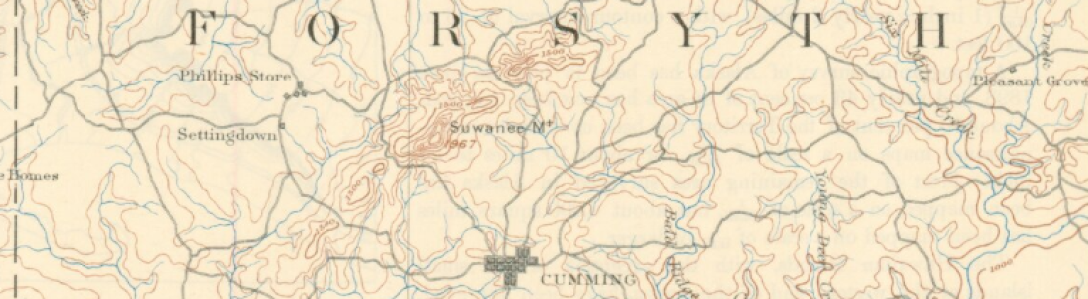
By 1912, brothers Alex, Warren, Charlie, and George Hunter had assembled one of the more substantial clusters of Black-owned land in Forsyth County, Georgia. Collectively, they controlled 159 acres, much of it concentrated near what is now the southern edge of the City of Cumming.
What distinguishes the Hunter family in the record is not only the amount of land they owned, but the way they engaged with it. Over several decades, members of the family bought, sold, refinanced, subdivided, and reassembled property in ways that suggest growing familiarity with real estate, credit, and long-term planning. At least 25 recorded deeds document transactions involving the brothers and their immediate family. This was not static ownership. It was active, informed, and increasingly sophisticated.
That momentum came to an abrupt end in late 1912, following the violent expulsion of Black residents from Forsyth County.
Warren Hunter: Frequent Transactions and Family Coordination
Warren Hunter’s land record reflects steady accumulation combined with frequent transactions. Beginning in 1899, he purchased a 40-acre tract in Land Lot 811. Over the following years, he bought and later sold smaller parcels, including a 2.5-acre tract along the Atlanta Highway2. Rather than representing simple expansion, these purchases and sales show repeated engagement with the land market.
Warren also acquired and later satisfied security deeds on a 20-acre tract in Land Lot 80, indicating the use of credit and the ability to clear obligations over time3. Several transactions involved transfers within the family. In 1907 and 1909, Warren sold small portions of Land Lot 81 to his brother George, then in 1910 bought acreage back4. These exchanges suggest coordination rather than liquidation.
On November 23, 1912, after more than a decade of ownership and management, Warren sold all remaining land at once, approximately 60 acres across Land Lots 81 and 805. His landholding history in Forsyth County ends there.
Alex Hunter: Early Ownership and a Significant Downtown Holding
Alex Hunter appears in the land records earlier than his brothers. As early as 1888, he owned a one-acre lot in the town of Cumming and later satisfied a loan on that property6. Over time, he continued to buy and sell town lots, maintaining a presence in the local real estate market.
One transaction in particular stands out. In August 1912, Alex sold a 7-acre tract located on or adjacent to the square in downtown Cumming and simultaneously purchased a 60-acre tract spanning Land Lot 140 and part of Land Lot 78.7
The timing is critical. This exchange occurred just weeks before the broader pattern of late-1912 sales that removed Black landownership from Forsyth County. By 1919, Alex had sold the 60-acre tract as well8. By 1920, Alex and Charlie appear in adjacent households in Douglas County, Georgia, suggesting that family continuity survived even as land ownership in Forsyth County did not.9
Charlie Hunter: Reclaiming and Losing Family Land
Charlie Hunter’s story highlights generational continuity and the role of extended family. Through his wife’s family, land in Land Lot 65 can be traced back to at least the 1880s.10 Taxes on this property were paid by Dorcus Pool beginning as early as 1885, indicating long-term, generational Black ownership well before Charlie himself appears as an owner.11
In 1903, Charlie and his wife, along with her siblings, sold what was described as “our mother’s place.” In 1910, Charlie bought the land back, purchasing his siblings’ interests and re-consolidating the property.12 This was a deliberate act of reclamation rather than speculation.
On November 8, 1912, Charlie sold the land again.13 This time, the sale came after the expulsion of Black residents from the county.
George Hunter: Participation Within a Shared Strategy
George Hunter owned less land than his brothers, but his role remains important. He acquired small parcels from Warren through multiple transactions and held land during the same period of expansion and consolidation14. His ownership appears closely tied to the family network rather than independent accumulation, reinforcing the impression that these brothers were acting in coordination rather than isolation.
An Abrupt End in 1912
What is most striking about the Hunter brothers’ land history is how suddenly it stops.
After years of buying, selling, refinancing, transferring land within the family, and reclaiming inherited property, every major holding connected to the family was sold in the fall and winter of 1912 following the violent removal of Black residents from Forsyth County. There is no gradual wind-down in the records. No intergenerational handoff. No indication that this was a planned exit.
Instead, the record shows a clean break.
The loss here is not only measured in acres. It is the erasure of momentum, the interruption of a trajectory that was clearly moving forward. The Hunter brothers had learned how to use land to build stability and opportunity. After 1912, that path was no longer available to them in Forsyth County.
Sources
- Forsyth County Deed Book W, p. 423. Forsyth County Clerk of Court, Cumming, GA.
- Forsyth County Deed Book Z, pages 214 and 215. Forsyth County Clerk of Court, Cumming, GA.
- Forsyth County Deed Book 1, p. 159. Forsyth County Clerk of Court, Cumming, GA.
- Forsyth County Deed Book 1 p 13, Deed Book 1 p 206, Deed Book 1 p 295 . Forsyth County Clerk of Court, Cumming, GA. (Two sales of one acre tracts to George, and repurchase of two acres)
- Forsyth County Deed Book 3, p. 2. Forsyth County Clerk of Court, Cumming, GA.
- Forsyth County Deed Book S, p. 360 and Deed Book U p 562. Forsyth County Clerk of Court, Cumming, GA.
- Forsyth County Deed Book 1, p. 565. Forsyth County Clerk of Court, Cumming, GA. (Purchase from and sale to C.T. Kemp. Two deeds recorded on same page.)
- Forsyth County Deed Book 3, p. 9. Forsyth County Clerk of Court, Cumming, GA.
- United States Census Bureau. Census of the United States, 1920 (Salt Springs, Douglas County, Georgia). Accessed via Ancestry.com. (Alex and Charlie appearing as adjacent names in census)
- Ancestry.com. Georgia, U.S., Property Tax Digests, 1793-1892. (Dorcus Pool paying tax on Land Lot 65-2-1 in years 1885, 1886, 1887 and 1890)
- ibid
- Forsyth County Deed Book 1 p 374, Deed Book 3 p 1. Forsyth County Clerk of Court, Cumming, GA. (Dorcus Pool heirs selling, Charlie later buying and buying back interest from wife’s siblings)
- Forsyth County Deed Book 1, p. 588. Forsyth County Clerk of Court, Cumming, GA.
- Forsyth County Deed Book 1 p 13, Deed Book 1 p 206. Forsyth County Clerk of Court, Cumming, GA.

 Lost Black Land of Forsyth County