In the documentary Banished, descendants of James Strickland returned to the land their family once owned in south Forsyth County. They walked the place where their ancestors had lived, farmed, buried their dead, and built a life before the 1912 expulsion.
For Charles Wiley, a grandson of Leola Strickland Evans, the land was not simply an old tract on a map.
“There’s some feel about a place that’s real. It’s like standing where my ancestors stood. There’s a peace here, from our beginning, in this land.”1
That feeling is difficult to capture in a deed book. But the records help explain why the place still mattered.
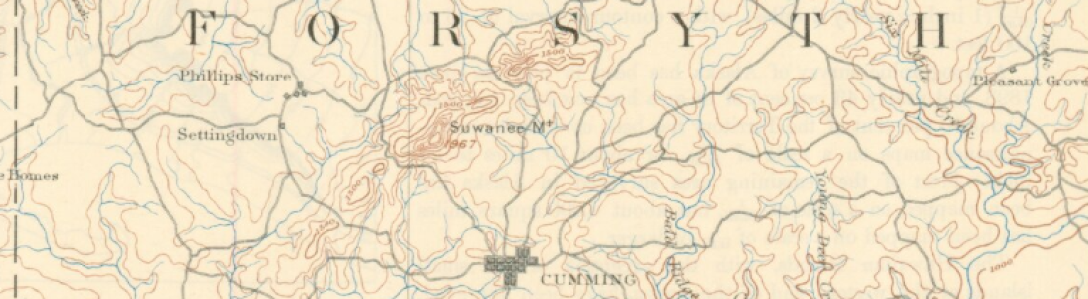
James Strickland owned land in Forsyth County for decades before the 1912 expulsion. His name appears in property tax records going back to the 1870s.2 By 1890, he was paying taxes on 80 acres in Land Lots 999 and 1000 in the 2nd District, 1st Section of Forsyth County. That land was in the Big Creek area, in what is now south Forsyth County.3
This was not a brief connection to the county. James Strickland was not a passing tenant or temporary landholder. The records show a Black landowner whose family had a long relationship with this land before the violence of 1912 broke apart Black life in Forsyth County.
What makes the Strickland land especially important is what happened after 1912.
In many land stories from this project, the records move quickly. A Black landowner disappears from the county. A deed appears soon after. The land changes hands. The paper trail may be incomplete, but the break is often visible.
James Strickland’s land was different.
Someone continued paying taxes on the Strickland land until 1918.4 After that, the tax trail appears to stop. But the deed records do not show the family’s known interests being fully sold until much later. The first known fractional sales by descendants and related heirs appear in the late 1930s. The final known sale came in 1943, when the widow and heirs of Willie Strickland sold their one-half interest in Land Lots 999 and 1000.5
That leaves a long and uneasy gap.
The family’s legal connection to the land appears to have continued for decades after 1912. But the records do not show who used the land during those years. They do not show who farmed it, who controlled it, whether the family received any income from it, or whether they had any practical ability to return to it.
The phrase that comes to mind is ownership on paper, absence on the ground.
That distinction matters. Land ownership is often treated as a clean legal fact. A person owns land until a deed says someone else owns it. But for Black families expelled from Forsyth County, ownership could become something more fragile. A family might still have a legal interest in land while being separated from the place itself.
The later deeds show how scattered the family had become.
In 1938, Jake Cohens sold a one-eighth interest in Land Lots 999 and 1000.6 That same year, Alonzo Cohen, then living in Jefferson County, Alabama, sold another one-eighth interest.7 Henry Julian sold another one-eighth interest connected to the same land.8 These interests appear to trace back through Lucinda Strickland Cohen, James Strickland’s daughter, and her children.
Then, in 1943, Willie Strickland’s widow and heirs sold a one-half interest in the land. The deed named Carrie Strickland, Joe Strickland, Ruby Strickland Parks, Guy Strickland, Lee Strickland, Maude Strickland Burse, Nora Strickland Hargrove, Leola Strickland Evans, William Strickland, Alta Strickland Evans, Village Strickland, and Ernest Strickland.9
Most of the family members were listed as living in Fulton County. Ernest Strickland was listed as being of Utah, but he appears to have signed the deed from Nebraska while in military service during World War II.10
By then, the old Strickland land had become something very different from the homeplace James Strickland had known. The heirs were spread across other counties and other states. One descendant was serving in uniform during a world war. Yet the deed still reached back to 80 acres in Forsyth County.
That is one of the quiet tragedies in this record. The land did not leave the family all at once. It lingered. It passed through heirs. It required signatures. It required descendants, long removed from the old homeplace, to release pieces of something their family had once held together.
The cemetery makes the story even harder to reduce to acreage and deed books.
A burial ground remains on or near the old Strickland property. In Banished, descendants visited the site and described its condition with pain. Dorothy Pemberton, a Strickland descendant, said:
“It made my stomach sick when I saw old truck doors, axles and general debris and garbage.”11
Her words are a reminder that this was not just farmland. It was a family place. It held memory, labor, inheritance, and graves.
Today, the former Strickland land sits in a very different Forsyth County landscape. A portion of the old 80 acres contains homes in the Laurel Springs subdivision. A large portion is now occupied by Sharon Elementary School. Lambert High School is adjacent, though not technically on the Strickland land. Other portions remain undeveloped.12
This is one of the reasons the land matters.
The Strickland property was not somewhere abstract. It was not an unnamed piece of rural land lost to time. It is part of modern south Forsyth County, surrounded by schools, subdivisions, roads, and daily life. Thousands of people pass near it, live near it, or send children to school on it without knowing the story beneath the landscape.
James Strickland’s 80 acres did not disappear in 1912. The family’s connection to the land remained in the records until 1943. But the life that made the land a homeplace had already been broken.
That long gap is the part that lingers.
From 1912 to 1943, the records show land still tied to a Black family that Forsyth County had forced away. They show taxes paid for a time, then silence. They show heirs scattered across Georgia, Alabama, Utah, and military service in Nebraska. They show descendants returning decades later and still feeling the weight of the place.
The deed book can tell when the land was finally sold. It cannot fully tell what was lost before that sale ever happened.
It cannot measure the years when the family’s name remained attached to the land, but the family itself could not remain there. It cannot show what it meant to stand beside an neglected cemetery and know that the ground once held a beginning.
James Strickland’s land remained after the family was gone. And in that space between ownership and absence, the deeper loss begins to come into view.
Sources
- Banished The Ethnic Cleansing Of Blacks in America YouTube https://www.youtube.com/watch?v=FayMoKwyoO4
- Ancestry.com. Georgia, U.S., Property Tax Digests, 1793-1892. (James Strickland paying tax on Land Lots 990, 1070, 1069 in years 1874-1878)
- Ancestry.com. Georgia, U.S., Property Tax Digests, 1793-1892. (James Strickland paying tax on Land Lots 1000, 999 in year 1890)
- Forsyth County Tax Digest (1913-1918), “Colored Digest,” Big Creek Militia District. Georgia State Archives, Morrow, GA.
- Forsyth County Deed Book 19, p. 136. Forsyth County Clerk of Court, Cumming, GA.
- Forsyth County Deed Book 13, p. 352. Forsyth County Clerk of Court, Cumming, GA.
- Forsyth County Deed Book 19, p. 119. Forsyth County Clerk of Court, Cumming, GA.
- Forsyth County Deed Book unknown. Forsyth County Clerk of Court, Cumming, GA. Henry Julian to L. B. Findley
- Forsyth County Deed Book 19, p. 136. Forsyth County Clerk of Court, Cumming, GA.
- ibid
- Banished The Ethnic Cleansing Of Blacks in America YouTube https://www.youtube.com/watch?v=FayMoKwyoO4
- Forsyth County GIS Viewer. Accessed May 2026.


