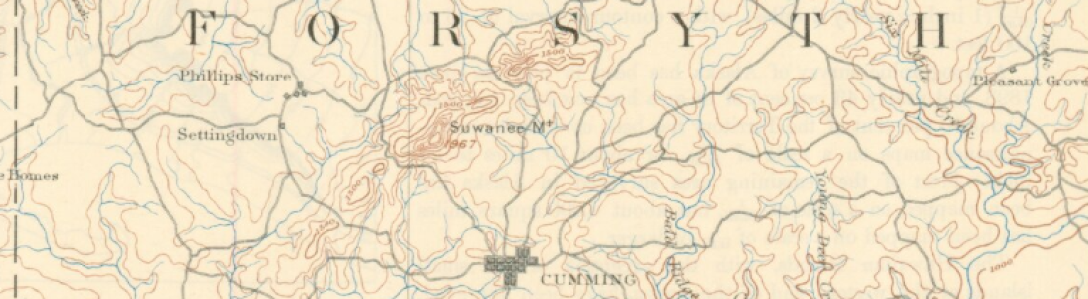
Lost Black Land of Forsyth County focuses on identifying Black landowners who held property in Forsyth County around the time of the 1912 racial expulsion and tracing what happened to that property afterward.
Because the surviving record is incomplete, the project relies on comparing multiple sources and distinguishing between what the records establish, what they suggest, and what remains unknown.
Establishing Land Ownership
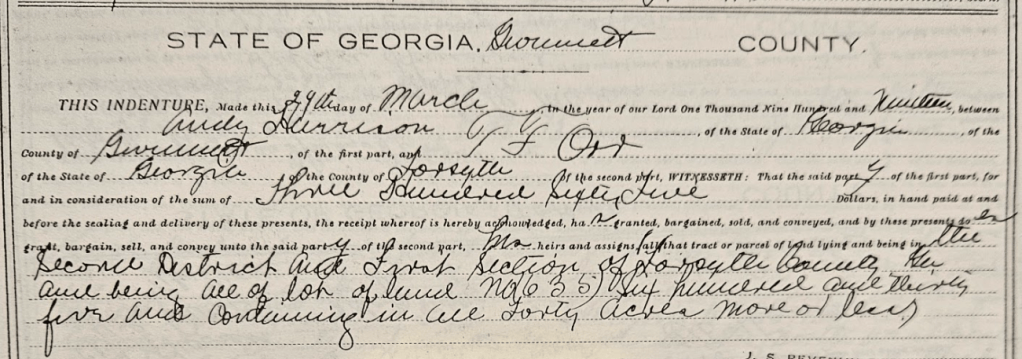
Recorded deeds are the strongest source used to establish the acquisition or transfer of land. When available, they provide the buyer and seller, acreage, land lot, district, section, date, and other details needed to reconstruct ownership. Deeds may also identify the residence of a grantor or grantee at the time of the transaction, providing useful evidence of where a former Forsyth County landowner was living after 1912.
Forsyth County tax digests are also an important source. They can associate a person with a specific amount of acreage and show changes from year to year. In some cases, a person appears in the tax records with land even though a corresponding deed has not been located.
Those entries are treated as significant evidence connecting the person to property, but not automatically as proof of recorded title. When the deed record and tax record cannot be reconciled, the discrepancy is left unresolved rather than explained through assumption.
Federal census records are used as a research guide, not as proof of land ownership. A census entry indicating that someone owned a home or farm can identify a possible landowner, but ownership is investigated through deeds, tax records, and other property-related sources.
Determining What Happened to the Land
A central goal of the project is to trace each property after 1912.
Existing accounts have reached different conclusions about Black land loss following the expulsion. This project does not begin with the assumption that displaced owners were either fully compensated or universally deprived of their property without compensation.
Instead, each property is examined individually. Recorded sales, inheritance, estate proceedings, debts, foreclosures, and other events are documented when the records support them.
A recorded sale price is not by itself treated as proof that an owner received fair value or was “made whole.” Likewise, gaps in a title history are not assigned explanations that the surviving records do not support.
Where the records do not provide an answer, the question remains open.
Mapping Historical Property
Land lots are central to locating property in this project. Many Forsyth County deeds identify land by land lot, district, and section.
Forsyth County’s modern GIS system allows those historic land lots to be viewed in relation to current roads, parcels, neighborhoods, and other features. This makes it possible to place historical property within the modern landscape with a reasonable degree of confidence.
Where an owner held only part of a land lot, acreage, road references, adjoining property, and other deed descriptions may help narrow the location further.
Maps on this site are intended as historical research visualizations, not legal surveys.
Missing and Conflicting Records
Historical records are incomplete and sometimes contradictory. Deeds may be missing, names may be misspelled, acreage may vary between sources, and tax records may not align neatly with deed records.
The project does not force those gaps into a complete title history when the evidence does not support one. Conclusions may be revised when additional records are found.
Use of Artificial Intelligence
Artificial intelligence tools have been used as a research aid for organizing notes, comparing records, assisting with transcription, exploring research questions, and drafting or editing text.
AI-generated suggestions, transcriptions, and interpretations are not treated as historical evidence. Claims presented on this site are based on the underlying sources, which are reviewed by the researcher before publication.
Sources
The project relies primarily on deed records, tax digests, census records, probate files, vital records, newspapers, and other historical materials.
A more complete list of sources is available on the Bibliography page.

