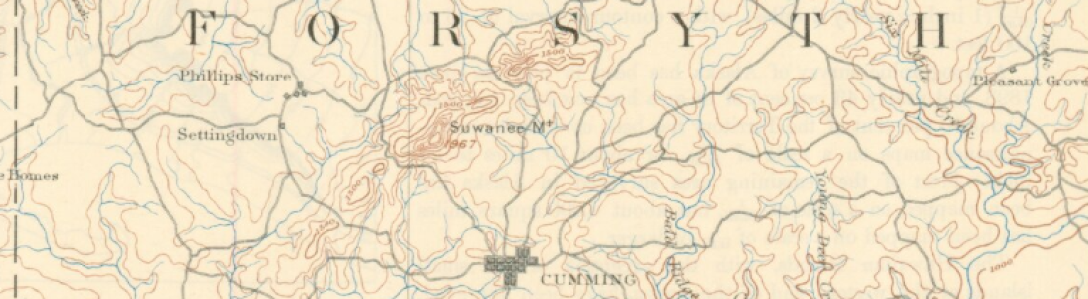
Cloverhill, the new residential development beside Cumming City Center, is being built on land once owned by Joseph Kellogg.1 More than a century before its streets and homes began taking shape, this land formed part of the largest Black-owned holding in Forsyth County.
Kellogg had approximately 200 acres when the county’s Black residents were violently forced out in 1912. His response differed from the rapid sales recorded for many other landowners. He borrowed against his property, delaying an outright sale for nearly two years.
That decision may have preserved something beyond a financial interest in the farm. It may have preserved the hope of coming home. It was a hope that would go unfulfilled.
Holding onto the Farm
By 1912, Kellogg was an elderly man with decades of his life invested in Forsyth County. In Blood at the Root, Patrick Phillips describes a holding that began with land inherited after his father Edmund’s death in 1874 and grew over the following years. Phillips also credits Kellogg with founding the Colored Methodist Campground in 1897.2
His land represented an established livelihood and a long family connection to the county. The 1912 tax rolls record approximately 200 acres, more than any other individual Black landowner in Forsyth.3
During the tumultuous fall of 1912, Kellogg arranged two loans secured by that property.
On October 17, he executed a security deed to B. P. Roper covering 43 acres. It secured two promissory notes totaling $669.42. On November 11, he executed another security deed to L. D. Stephens, covering a stated 165 acres and securing $650.4
These were transactions involving debt rather than straightforward sales of the farm. They allowed Kellogg to borrow against his holdings while postponing an outright disposal of the property.
Among the landowners documented by the Lost Black Land project so far, Kellogg is the only identified example of someone using this approach during departure. Other owners’ records show sales occurring quickly after the expulsion.
His financial connection to Forsyth continued. The land remained listed under his name in the 1913 and 1914 tax digests. Similar entries appear for other displaced Black owners, but alongside Kellogg’s security deeds, they help document his continuing connection to the farm after he had left the county.5
A Strategy, and Perhaps a Hope
In Buried in the Bitter Waters, Elliot Jaspin describes Kellogg as having “outfoxed” his persecutors. His interpretation emphasizes the practical advantages of borrowing instead of immediately selling. The loans could provide a financial cushion, while the lenders’ interest in the property gave them a reason to preserve it.6
Phillips offers a similar explanation, while observing that those same financial interests could give lenders a reason to benefit from Kellogg’s continued absence.
Both interpretations recognize a man accustomed to making decisions about land and money. But “outfoxed” suggests a clearer victory than the eventual outcome supports.
Kellogg may have been trying to buy time.
Borrowing against the farm could help sustain his family elsewhere without immediately surrendering the land to which they might return. If the violence subsided and conditions changed, an outright sale would not yet have closed that possibility.
The deeds cannot establish what he expected. They record his arrangements, not his private intentions. Still, his decisions are consistent with someone trying to survive an absence he hoped would be temporary.
The Eventual Sale
On March 22, 1914, an advertisement in The Atlanta Constitution offered 200 acres in Forsyth County and a business lot on Cumming’s public square. It also offered an exchange for “negro property.”7
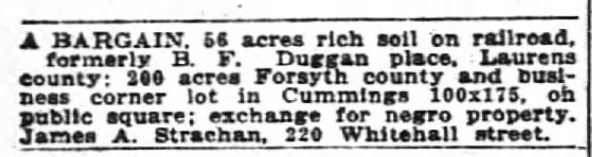
Phillips associates this advertisement with Kellogg. The acreage makes that identification plausible, but the listing does not name him. Its contact was James A. Strachan at 220 Whitehall Street, and it also advertised a separate property in Laurens County. A broker or intermediary may have combined several holdings in one notice.
Ownership of the Cumming square lot has not been established by the deeds reviewed for this project. The advertisement remains suggestive rather than conclusive evidence of Kellogg’s efforts to find a buyer.
The next major transaction is definite. On July 2, 1914, Joseph Kellogg, identified as a resident of Cobb County, conveyed approximately 210 acres to E. L. Tatum for a stated consideration of $2,400.8
The deed also included “one half the rents upon said place for the present year.”
That provision indicates that rental income remained part of the farm’s financial arrangements at the time of sale. Kellogg may have received income from the property during his absence, although the deed does not establish what he collected in the preceding years. Nor does the stated consideration reveal what remained for him after any outstanding debts were settled.
Nearly two years after the expulsion, he sold the farm.
Decisions under Extraordinary Pressure
By 1920, Joseph and Liza Kellogg were renting a home on Montgomery Street in Marietta with several relatives. He died there in 1927.9
His land dealings reveal something of the choices displaced families faced. Whether to sell, borrow, wait, or seek property elsewhere became an urgent decision shaped by circumstances they had neither chosen nor controlled. Immediate needs had to be weighed against the value of a lifetime’s work and the uncertainty of what might happen next.
Kellogg brought considerable experience to those decisions. He had accumulated land and managed a substantial holding. Yet his business judgment now had to operate within a county where racial violence had made remaining at home impossible. Whatever options appeared on paper, his ability to use them was constrained by his exclusion from the place where his property lay.
His security deeds suggest an effort to preserve room to maneuver. Borrowing could meet immediate needs while leaving a future sale undecided. Continued ownership could retain an income source and perhaps leave open a path back.
For nearly two years, that connection endured. If it carried a glimmer of hope that he might return, the hope did not become reality. The eventual sale closed the period in which he had held onto the farm from outside Forsyth County.
Today, Cloverhill is giving this land another future. Kellogg’s records preserve an earlier one that was interrupted: a family remaining on its farm, an elderly landowner continuing his work, and the possibility of passing that holding to another generation.
The deeds cannot say how long he believed those things were still possible. They show that he did not give up the property immediately. Under extraordinary pressure, he found a way to hold onto it a little longer.
Sources
- “Another growth spurt set for Cumming’s made-from-scratch downtown”, Urbanize Atlanta. https://atlanta.urbanize.city/post/cumming-city-center-toll-brothers-development-downtown-construction
- Phillips, Patrick. Blood at the Root: A Racial Cleansing in America. Page 12
- Forsyth County Tax Digest (1912), “Colored Digest,” Cumming Militia District. Georgia State Archives, Morrow, GA.
- Forsyth County Deed Book 1 Page 575 and Book 1 Page 582. Forsyth County Clerk of Court, Cumming, GA.
- Forsyth County Tax Digest (1913 and 1914), “Colored Digest,” Cumming Militia District. Georgia State Archives, Morrow, GA.
- Jaspin, Elliot. Buried in the Bitter Waters: The Hidden History of Racial Cleansing in America. Page 135.
- “A Bargain”, classified ad, The Atlanta Constitution; Publication Date: March 22, 1914.
- Forsyth County Deed Book 3, Page 215. Forsyth County Clerk of Court, Cumming, GA.
- United States Census Bureau. Census of the United States, 1920 (Marietta Ward 5, Cobb County, Georgia). Accessed via Ancestry.com


